Anxiety at Night
Why You Feel Restless When You’re Trying to Sleep

Everything is quiet.
No noise, no phone, no distractions — and suddenly you feel restless, tense, or anxious. Here’s why anxiety can feel stronger at night, what your nervous system may be responding to, and what can help you feel safe enough to let go.
You’re lying in bed.
Everything is quiet.
No conversations.
No notifications.
No distractions.
And somehow, that’s exactly when everything inside you gets louder.
At first, it may be barely noticeable.
A little tension.
A feeling you can’t quite name.
But the more attention you give it, the more present it becomes.
The Most Important Things to Know
Feeling restless, anxious, or strangely unsafe at night can be overwhelming — especially when there seems to be no obvious reason for it.
In this article, you’ll discover:
why anxiety and restlessness can feel stronger at night
what your nervous system may be responding to
why fighting the feeling often makes things harder
what can help your body reconnect with a sense of safety
and how to gently find your way back to the present moment
Restlessness and anxiety at bedtime don’t always have an obvious trigger. And they don’t necessarily begin at night.
Nighttime may simply be when you finally notice them.
What stayed quiet during the day suddenly has room to be heard. And your nervous system doesn’t necessarily need another distraction from it.
It may need something entirely different: a sense of safety.
You may know the feeling.
During the day, everything seems more or less fine.
You’re busy.
You’re getting things done.
You may even feel calm, grounded, and completely okay.
And then night comes.
Suddenly there’s pressure in your chest. Restlessness without a name. A vague feeling of:
“Why does everything suddenly feel like too much?”
That doesn’t mean you’re weak.
It may simply mean your system has been carrying something that didn’t have much space during the day.
Why Anxiety can feel worse at Night
During the day, our attention is constantly pulled outward.
Conversations. Tasks. Movement. Messages. Decisions. Noise.
We don’t have to consciously suppress anything for this to happen. It’s simply what daily life does: it keeps our attention occupied.
Then evening arrives.
The world becomes quieter.
And our attention begins to turn inward.
What we notice there isn’t necessarily new.
It may be tension, uncertainty, worries about the future, unresolved emotions, or the uncomfortable feeling that we can’t control everything.
These things may have been present all along.
We simply hear them more clearly when everything else becomes quiet.
And sometimes nighttime seems to say:
Now there’s space.
Good to know
Anxiety that seems to appear “out of nowhere” at night may not actually have appeared out of nowhere.
It may simply have become easier to notice once the distractions of the day disappeared.
That isn’t failure.
It’s awareness.
What your nervous system is looking for
Your autonomic nervous system is constantly working to help protect you and respond to what is happening around and inside you.
When it detects uncertainty, stress, or possible danger — consciously or unconsciously — your body can become more alert.
Your heart may beat faster.
Your muscles may tense.
Your breathing may change.
And sleep suddenly feels much farther away.
You experience it as:
restlessness, anxiety, tension,
or simply being wide awake for no obvious reason.
But your nervous system isn’t necessarily malfunctioning.
It may be doing exactly what it was designed to do: trying to protect you.
WHAT OFTEN DOESN’T HELP
Trying to push the anxiety away
Telling yourself to “just think positive”
Frantically distracting yourself
Trying harder and harder to fall asleep
The more the feeling becomes something that has to disappear, the more attention it receives.
And suddenly you’re not only anxious.
You’re anxious about being anxious.
WHAT CAN HELP INSTEAD
Rather than making your first goal:
“How do I get rid of this feeling?”
try another question:
“What would help my body feel a little safer right now?”
That small shift changes everything.
The Spiral — and how to step out of it
One thought appears.
Then a feeling.
The feeling creates another thought. And that thought creates another reaction.
Before long, you’re caught in a spiral of worry, tension, and uncertainty. And often, the hardest part isn’t even the original feeling.
It’s the sense that you’re trapped inside it.
Sleep doesn’t need discipline. It needs safety.
The way out isn’t more control.
It’s connection. Connection with your body. With your breath. With the room around you. With the moment you are actually in.
What Helped Me on Nights Like These · Nicole
I’ve had nights when everything suddenly felt heavy. And there wasn’t always a clear reason. Sometimes it was simply this vague sense of uneasiness I couldn’t explain.
What didn’t help?
Trying to think my way out of it. Pulling myself together.
Telling myself: Come on. Be reasonable.
What did help was surprisingly simple.
No elaborate technique. No complicated exercise.
Just my steady breathing and one quiet reminder:
“I am safe. Everything is okay.”
Why This Simple Sentence Helps Me
Not because the words are magic. They aren’t.
They help because they bring my attention back.
Back to the present. Back to my body. Back to what is actually happening right now.
And right now:
I’m lying in my bed.
I can feel the mattress underneath me.
I’m warm beneath the covers.
I’m here.
And in this moment, I am safe.
What can help your body feel safe
Safety doesn’t simply come from having a perfectly quiet bedroom. And it doesn’t require every worry in your life to disappear.
Sometimes it begins much smaller. With signals that tell your body:
I’m here. I’m with myself.
If you’re lying awake tonight and that familiar restlessness appears, you don’t have to immediately make it disappear.
Instead, try this.
Create Gentle Physical Contact
Place a hand on your chest or abdomen. Feel its warmth. Feel the movement underneath your hand as you breathe.
Gentle, reassuring touch can help bring your attention back into your body and the present moment.
You’re giving yourself something tangible to notice:
I’m here.
Let Your Exhale Become Longer
Try breathing in gently for four seconds and breathing out for six.
There’s no need to get the timing perfect.
A slower, longer exhale is associated with parasympathetic activity and can help support the body’s shift toward a calmer state.
If counting makes you more tense, forget the numbers.
Simply let your exhale become a little slower and softer.
Name the Present Moment
Quietly remind yourself:
“I’m in my bed. I’m here. In this moment, I’m safe.”
You don’t need to force yourself to believe anything. Look at what is actually true around you. Feel the mattress. Hear the sounds in the room. Notice the blanket against your skin.
Come back from what if to what is.
The Shift That Matters
Instead of:
How do I make this anxiety stop?
ask:
What does my system need right now to feel a little safer?
At first, that question may feel unfamiliar. That’s okay. You’re practicing a different response.
Why Your Intention Matters
There’s something we tell our participants again and again:
Your intention matters.
There is a big difference between breathing because you desperately need to make anxiety disappear…
and breathing because you want to offer your body a moment of calm.
Between fighting yourself…
and supporting yourself.
Your intention can be as simple as:
I want to slow down.
I want to stay with myself.
I want to give my body permission to rest.
You don’t need an immediate, perfect response. This isn’t another bedtime performance.
It’s practice.
Why Calm Doesn’t Have to Begin Outside of You
The world is noisy.
And yes — life doesn’t always feel predictable or safe.
You cannot control all of it before going to bed. Thankfully, sleep doesn’t require a perfect world. What you can influence are the signals your body receives right now.
A slower breath. Warmth. Familiarity.
A quiet room.
The feeling of the mattress underneath you.
A gentle reminder: Right now, I’m here.
This is where our 7-Night Sleep Journey began
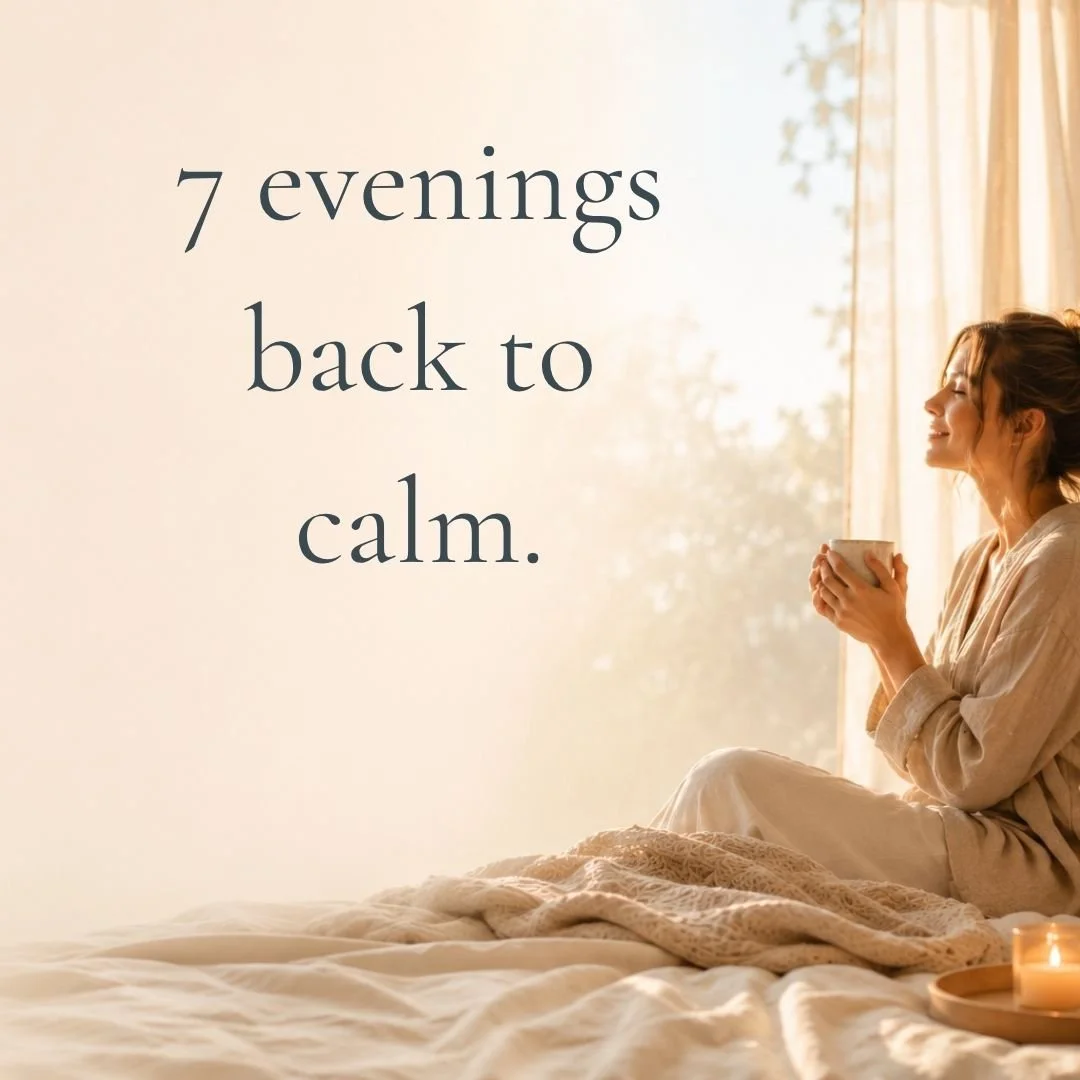
It began with nights exactly like these.
Nights when letting go felt difficult.
Nights when the body was tired but something inside remained alert.
And the desire to find a gentler way back to rest.
That became our 7-Night Sleep Journey.
Seven guided evenings designed to help you move step by step:
from activity toward rest,
from racing thoughts toward awareness,
from tension toward connection,
and from trying to sleep toward allowing sleep to happen.
One of those seven evenings is devoted entirely to Emotional Safety — the same meditation we share as our free sleep meditation.
Because for us, this is one of the most important foundations of sleep:
You don’t force your body to let go.
You create conditions in which letting go becomes possible.
You’re Not the Only One Who Knows This Feeling
That strange nighttime restlessness.
The pressure you can’t explain.
The thoughts that suddenly seem louder.
These experiences are deeply human.
Your nervous system responds to what you experience, what you anticipate, and what you carry with you into the night.
Understanding that response can change the question from:
“What’s wrong with me?”
to:
“What is my body responding to — and what does it need right now?”
And that is a very different place to begin.
FAQ: Restlessness and anxiety at bedtime
Why does anxiety feel worse at night?
During the day, your attention is occupied by conversations, tasks, movement, decisions, and external stimulation. At night, many of those distractions disappear. Thoughts, emotions, and physical sensations that were already present can suddenly become much easier to notice.
Why am I anxious at night for no reason?
There isn’t always one obvious reason. Stress, uncertainty, unresolved emotions, physical tension, anticipation about the next day, or an activated nervous system can all contribute. Sometimes what feels like anxiety appearing “for no reason” is simply something becoming noticeable once the day gets quiet.
What can I do when I feel restless in bed?
Start by taking the pressure off sleep. Gentle physical contact, noticing your surroundings, and slowing your breathing can help bring your attention back to the present moment. Instead of immediately trying to eliminate the feeling, ask what might help your body feel a little safer and more settled right now.
Can meditation help with nighttime anxiety?
Meditation can be a useful way to shift attention, slow down, reconnect with the body, and create a calmer transition into sleep. For some people, guided meditation can be especially helpful because there is a voice to follow instead of having to “quiet the mind” on their own.
Your Takeaway for Tonight
Sleep begins with safety.
Not with forcing yourself to stop thinking.
Not with getting everything right.
But with small moments in which your body begins to recognize:
I’m here.
I’m with myself.
And right now, I can rest.
Sleep Begins With Safety

Imagine giving your body a few minutes in which it doesn’t have to do anything at all.
No fixing.
No forcing.
No trying harder to sleep.
That’s what our free guided sleep meditation is designed to offer you.
For 19 quiet minutes, we guide you into an inner space where your body can slow down and reconnect with a sense of calm, comfort, and emotional safety.
And sometimes, that’s exactly where sleep begins.
You’ll also receive our SoulNotes — honest, thoughtful emails about sleep, the nervous system, and life in between.
No noisy newsletters.
Just words and practices designed to support you.
🌙 GET YOUR FREE SLEEP MEDITATION
The meditation is yours to keep. The SoulNotes stay with you for as long as they feel helpful.
Inspired by the SoulmeditationBreath® approach — bringing together science, breathwork, meditation, and energy work.
SLEEP SERIES · EXPLORE ALL ARTICLES